Tau-Tongue Articulator: The "Hello World" Tutorial
Let’s do a “Hello, World” style tutorial with the Tau-Tongue Articulator
We’ll do a retro-futuristic, pulpy, urban-fantasy-noir kinda story.
I’ll show you how a symbolic algebra can help you tell stories you didn’t know you had in you, or that I didn’t know I had in me, for that matter.
- Go to articulator.tautongue.com
- Click “New Articulator Session”
- Start writing a 5-7 word sentence like “Tau-Tongue, tell me a story, please” - If you type that in exactly as I wrote it there, you can follow along. Tau-Tongue is deterministic. So if you and I both type in that phrase, we’ll both be given the same equation to work from. And we can both come up with wildly different results.
Here’s what I want you to do… Think of the genre(s) of fiction that you normally enjoy reading, or that you’ve always wanted to try your hand at writing… That comes with certain elements that must be present right? In Sci-Fi you’ve always got some sort of speculative-angle on the future or tech that doesn’t currently exist in our world being used or somehow playing a part in the story, right? In action you always have a good chase scene, a wild fight scene, etc. These are creative constraints. They limit what CAN happen so that you can focus on what MIGHT happen IF you put your pen to the paper, so to speak.
-
Thinking of the type of genre you’d like to write in, use the phrase you’ve typed into the articulator (don’t click that “create crucible” button just yet!) and the output it generates to begin thinking of what the main character might be like in the story you’re going to create. At this stage I like to have a notepad or notes app open that I can jot ideas down into.
-
If, in the Articulator, you also typed “Tau-Tongue, tell me a story, please,” you’ll see the same Crucible SummaryThe combination of the Proto-Crucible, Antagonist and Braid Length description in the Tau-Tongue Articulator Application at the center of your Articular Screen. This is what we’re going to use to decide if we Vibe with what Tau-Tongue is giving us or not.
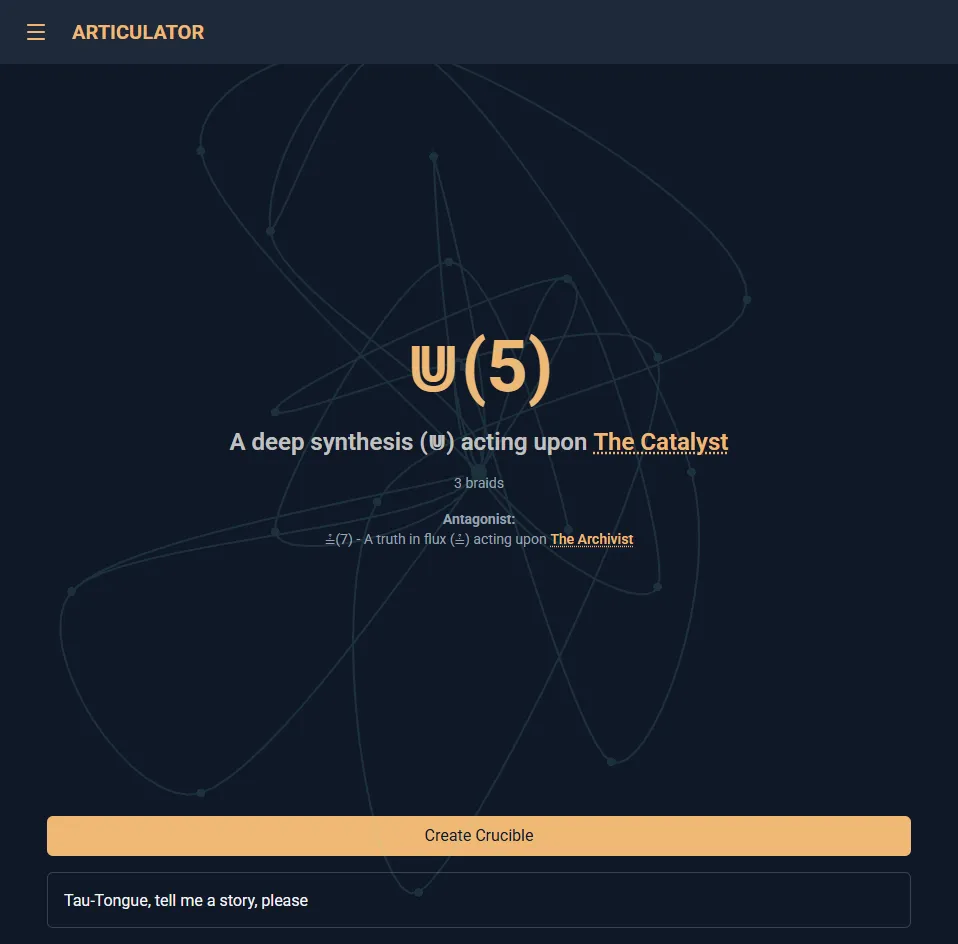
See - if the prompt there isn’t giving you any ideas after a few minutes, just edit your phrase in the input… I like to edit so that I’m still capturing my original vibe, but saying things slightly differently - with more or fewer words. That kind of energy is what I’m bringing to the exercise right now. But me? I’m pretty happy with the current Crucible.
Now remember, I said I wanted to create a sort of Urban Fantasy Noir story. That adds some constraint right there. The main character? Probably not a Hero-type. The world? Dark, gritty, full of bad apples and fallen types. There’s a hint of danger around every corner, and if you walk down the wrong alley way with your shoulders hunched just so, you might end up in an acid-drenched tilt-a-whirl version of the city waiting to scare the life of you, right?
And we’ve got this Proto-CrucibleA symbolic algebra function representing the central theme or pressure in your story. here of ⋓(5), “A deep synthesis acting upon the CatalystOne who initiates change and transformation, sparking new possibilities” - Well if we click on the “Catalyst” to get more information about that ArchetypeArchetypes are like general descriptions just vague enough, but just specific enough to indicate a specific type of Vibe/Person/Place/Thing in a story. we’d find that the Catalyst represents change/disruption/transformation. Chaos. I love it. And a “deep synthesis” in an Urban fantasy Noir? That’s sounding to me like some kind of power or ability above and beyond what a normal human can do. So I’m going to tuck that in my hat and then look at the Antagonist next.
For The AntagonistThe opposing force(s) acting in opposition to the main character's goals in your story we have a different crucible altogether. We get ≟(7), “A truth in flux acting upon The ArchivistOne who preserves knowledge and wisdom, maintaining continuity through time..”
After thinking on it a moment of two, this makes me think of Memory and Time. A truth in flux acting upon Memory/Time. What’s real? What actually happened back “when”? That could be a theme of the story. And when you combine that with the Proto-Crucible it makes think about a person who stumbles upon the ability to go back in time but when they try to interfere and change things it creates dual, conflicting memories in them, and the minds of those involved in the altered event that might lead to like, I don’t know, psychosis or something. Pretty gritty. I like it.
We’re cooking now, so I’m going to go ahead and click that “Create Crucible” button and start a new articulator session with this Spark! “Tau-Tongue, tell me a story, please” as an input, see, the system doesn’t care that it has nothing to do with what I’m writing because that’s not why I created it. I created it to provide structure I can brainstorm upon so that I don’t have to think ideas up from an open-field of possibility. There-in paralysis and “block” is found, am I right?
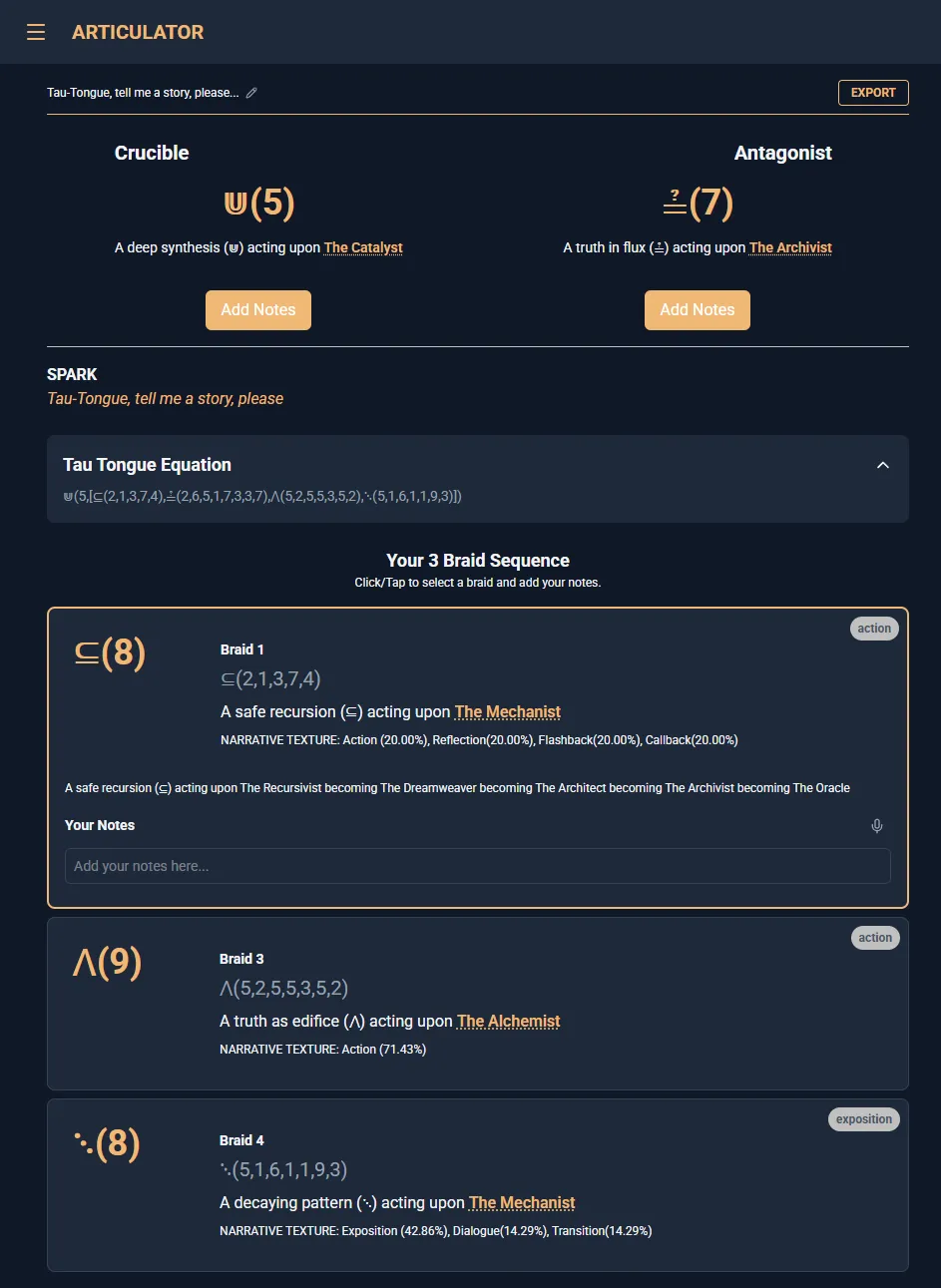
Let’s break it down as there’s a lot information packed into the Session View of the Articulator. What’s the Articulator? It’s a specialized note-taking app for Narrative Generation. An Outlining tool for creating emergent fiction.
Crucible Summary
Up top you have the Crucible Summary section which shows you your Proto-Crucible versus the Antagonist Crucible. These two combined form the creative constraints for your story’s core theme and arc. Spend some time here filling up those note sections. Revisit and add to them often. You’re building a whole world and set of Characters here. The Notes fields are where you’d rough out your core ideas, characters, maybe sketch the sequence of events.
Then beneath that you have “SPARK” which is just your input, so you can confirm you’re in the right project and can see your starting point at any given time. In our case, our spark is unrelated to what we’re writing. I did that deliberately to show you that the magic isn’t necessarily in your input. It’s in the structure Tau-Tongue derives from your input.
The Tau-Tongue Equation
⋓(5,[⊆(2,1,3,7,4),≟(2,6,5,1,7,3,3,7),⋀(5,2,5,5,3,5,2),⋱(5,1,6,1,1,9,3)])
This is the symbolic algebraic structure from which your story will emerge, in full. All the information you need to craft a narrative is compressed into that funky symbolic string, which you’ll see expanded in the Braid Section here in a moment.
There are two main components to every equation. The Proto-Crucible and the Braid.
The Proto-Crucible is always the outermost symbol + the first number in the outermost parentheses of the equation. This represents your story’s Protagonistic view (main-character perspective) of the core theme.
The Braid is the list of symbolic functions contained within the square brackets. These represent individual beats or events that occur in your story’s timeline when using the Articulator to define a story outline.
On the Equation’s Versatility
You can do more, much more with Tau-Tongue equations and the Articulator than just outline story concepts. You can write songs, create characters, worlds, magic systems (probably)… It’s all in how you treat the braids, in my opinion. The Proto-Crucible and Antagonist seems to be easy enough to understand from application to application right? Those are always your core themes surrounding the thing being brainstormed. I hope that makes sense.
The braid’s utility varies, however between Story, character, world, and lyrical applications.
- Story - In a story outlining context, the braid purpose varies depending on scale of the outline. If you’re really zoomed out… Meaning in the articulator, you’ve provided a shorter input with fewer braids, you’ll be looking at each braid entry as an Act or a Book, right? But say you write an input that generates 26 braid entries. That sounds more like each braid entry as key Scene in the story right? You feel me? So bring that thinking to your Articulator sessions and you all of a sudden have a metric for measuring how much story you’re committing to with a given equation, right?
- Character - As a character development tool, I like to treat the Braids as pinnacle moments in a characters life leading up to the story, or describing different facets of their personality. This perspective helps me create nuanced, multi-dimensional characters that practically jump off the page, feeling more cinematic and thought out because it allows you to dig into the motives and desires of the character with some exploration.
- World - For world building, Braid entries usually get treated based on the scope of the World I’m building. If it’s a Space Opera, it might be different settings within the story across multiple planets. One might be a ship. That’s up to me as the author, but what I’ll do is assign a location to each braid and then use the symbolic function of that braid to determine it’s characteristics. It’s fun and usually this aspect involves me chatting it up with an LLM to really dig in. Great exercise.
- Lyrics - Pretty straightforward, you read each braid entry’s symbolic function as a stanza or verse. I don’t do this much, I admit, but I have written more than a handful of songs this way and they were all wonderfully weird.
So how do you interpret a braid equation? Let me introduce you to BraidcraftThe act of interpreting Tau-Tongue equations into narrative structure!
In Part 2, we’ll learn Braidcraft - the six rules for reading and interpreting braid equations. That’s where the real magic happens.
In the meantime, hit up the Articulator and start brainstorming!