You've never been surprised by your own writing, until now.
You’ve never been surprised by your own story. Until now.
A Tau-Tome is a “full-circle book” that’s what it means. You imagine the book. You co-create the book. You read the book. You edit the book. You share the book. You talk with other readers about the book. Full-circle.
So how do you make them, and at what cost?
That’s the best part. It’s an afternoon and a cup of coffee kind of vibe. Make the coffee at home, spend the money you save to get a Tau-Tome. That kind of cost.
Let’s go.
Go ahead and put the coffee on, then come right back. We’ll need 3-5 minutes here, anyway.
Back? Great. Now go to TauTo.me. Register. Sign In.
Click “Discover” on the dashboard.
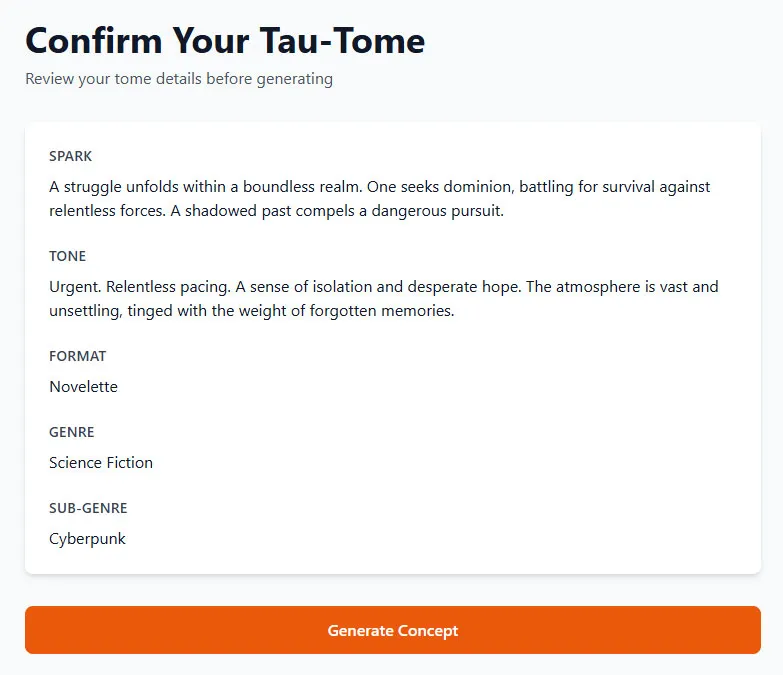
Input a simple 1-2 sentence story idea that you’ve always wanted to read in the SPARK field.
Write a quick tone statement, how should the story leave the reader feeling, what’s the prose like, the dialogue? Short. 512 characters.
And that’s all the writing you’ll need to do for a bit. Once you’re happy with your Spark and Tone, click through to the “GENERATE CONCEPT” button and click that.
Now go get that coffee. I bet it’s ready now.
Oh nice, you’re back!
What Tau-Tome is Probably Doing Right now
So if you made it back with your coffee and Tau-Tome is still on the same screen with the greyed-out “Generating” button, I’ll tell you why. It’s in the background, taking that spark of an idea and that tone statement and expanding, or decompressing it, if you will, into narrative structure using a custom symbolic algebra I created called Tau-Tongue.
Tau-Tongue is interesting for creative writing because it allows you to be creative within a constrained area. While it’s not exactly paint by numbers, the structure it asks you to consider when planning you stories is not what you would typically come up with on your own, for one, unless you’re already into Archetypally driven narrative construction of course. 😉 So - the Spark you gave gets turned into what we call a Tau-Tongue equation. They look like this:
∥(9,[≹(1,1,2,7,5,3,5,2,1),≏(9,3,7,6,4,6,6,6,5),∙(3,5,3,3,3,3,4),≠(6,1,5,5,1,4),⊣(9,2,8,5,1,5,2,3,9,1,3,9,1,4,7,3,5,9,5,2,9,1),⋀(9,1,4,4),≂(9,5,5,6,2,9,1,1,6),≕(1,5,1,6,3,2,1,5),⋫(5,9,2,3,5,5),⊇(9,5,7,1,9,5,1,6,7,9,9),⋷(6,1,4,2,3),≝(9,4,7,3,1,1,1),≯(1,9,5,6,1,5,7,5),≋(5,8,1),⊩(6,5,4,4,1),√(2,3),∦(1,4,1,1,3),∄(5),⋳(6,3,7,2,3)])
Believe it or not, that’s a whole story complete with a central conflict, antagonist… looks like 18 scenes or key events. A good novella’s worth of story sitting right there. Waiting to be decoded.
Let Tau-tome cook. That’s what it’s doing right now. It’s expanding that equation into a full blown 18-scene outline (in my example) with an explanation of the Central Theme, Characters, as well as a Title and overall story summary.
Wow. haha. That’s a lot. But like I said, cozy up with that cup of coffee because if you check back in on Tau-Tome, it’s probably done with all that by now.
And you’ve only just had your first few tentative sips…
Let’s head on over to the “Excavation Site”
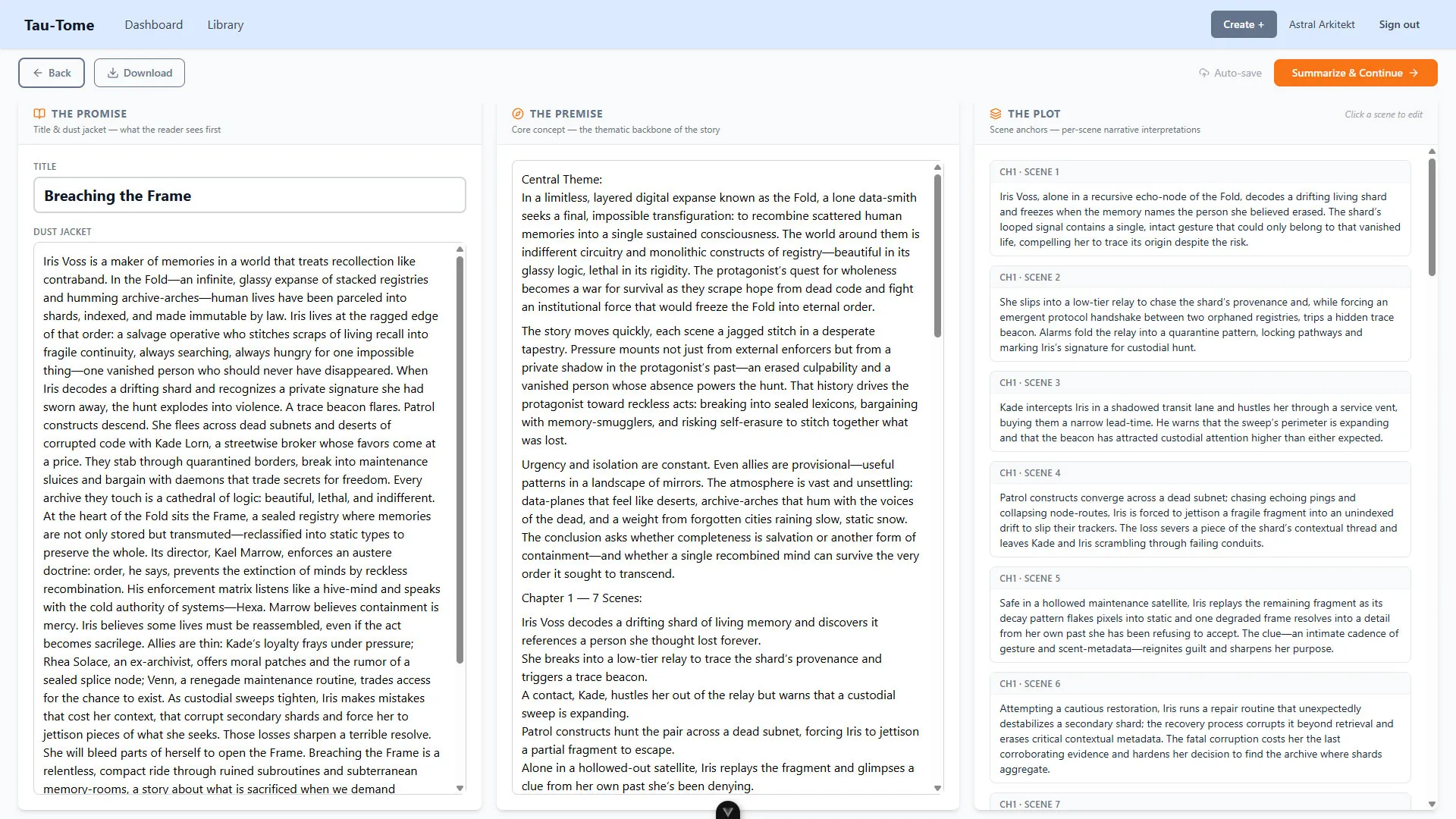
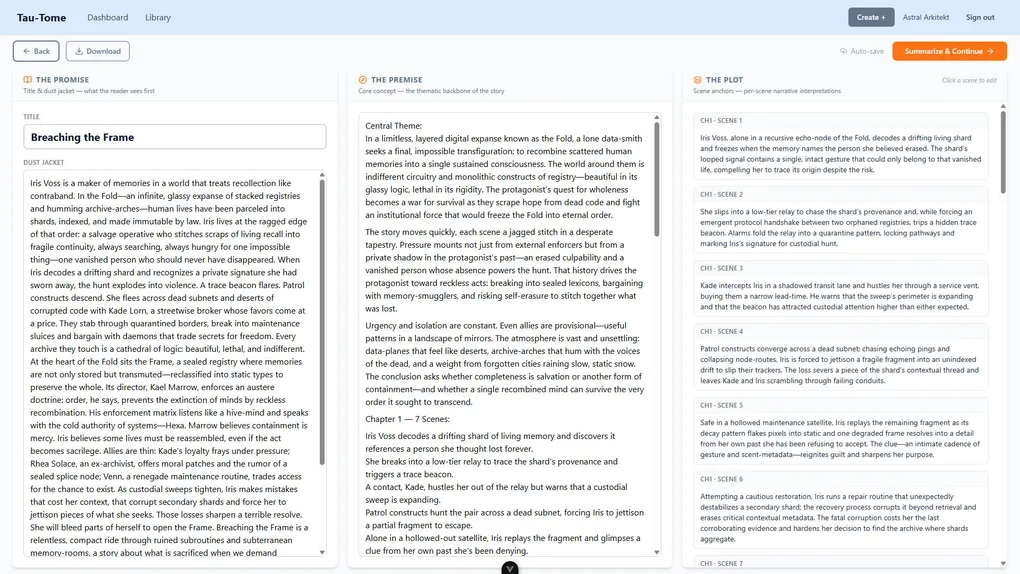
When the app responds next it will display an excavation site for your story zoned off into three distinct sections, The Promise, The Premise, and The Plot. The Three P’s of Tau-Tomery, if you will.
- The Promise - Your title and “marketing copy” or “back cover matter” - the story’s teaser
- The Premise - The central theme, conflict and characters in the story
- The Plot - Key events in the plot of your story that play out the narrative unearthed from your spark.
Here you’ll make your choices, you can simply read and accept as is, you can edit small things like character names, or you can go crazy on the whole thing column by column. Everything here is editable. Don’t like a plot point? Click on it and edit it until it feels just right.
PRO TIP: Before you change anything, read two scenes ahead and one behind. Every artifact connects to the others.”
The goal on this screen is to try and massage what you’ve got by editing. Small motions. Simple changes here. We’re easing into the writing by discovering first what we do and don’t like for our emerging fiction, here.
This is like being given access to an archaeology site rife with artifacts, and it’s you who gets to discover and tell the story of what these artifacts mean, here and now.
Take your time here. But don’t get so engrossed you let the coffee get cold!
Once you’re done excavating your ideas from the clay of this concept, and you’ve removed all the dirt and debris that didn’t suit you, you’re ready to click the “Summarize & Continue” Up top. Next you’ll go to the outline expansion step. This is where we brush away the remaining dust and start to see the full shape of what we’ve unearthed.
This might take a while depending on the length of the story you chose to create. I ended up with a 32-scene story in mine, so I’ll need to find something to do for about 30 minutes or so. The coffee’s almost gone. Maybe time for a snack and another cup while Tau-Tome cleans up our archeological finds!
Did you get that second cup of coffee? I did.
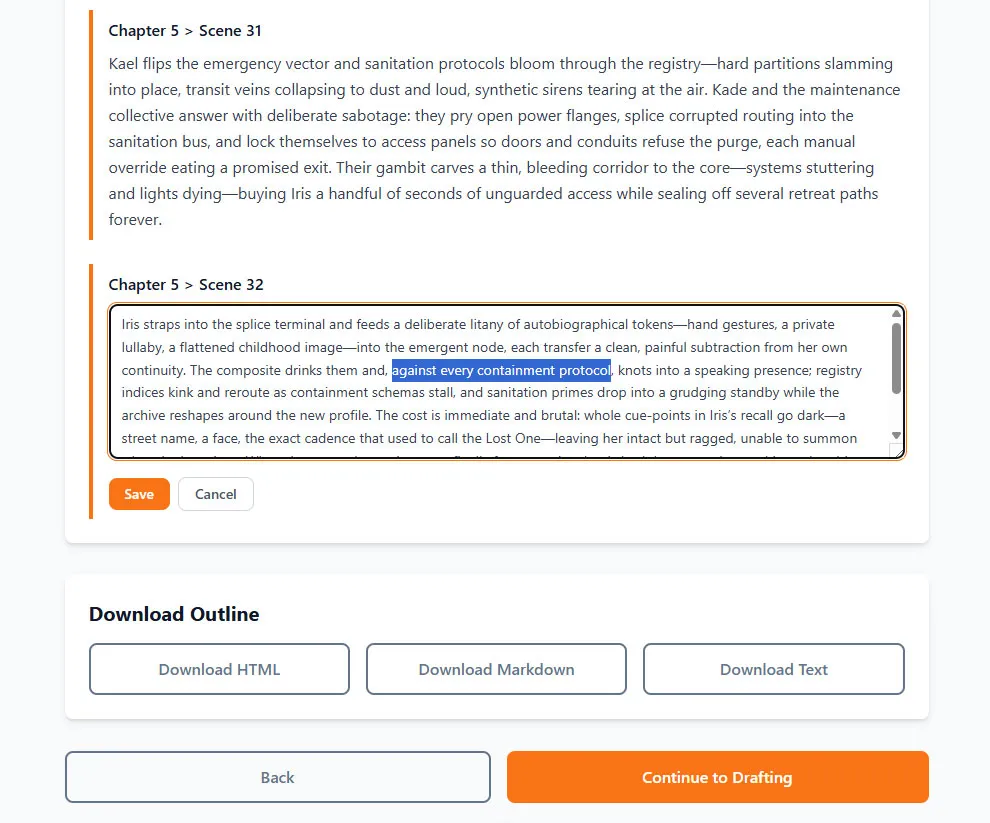
As the outline comes in you can edit or revert each scene to your previously constructed scene description. Like before, you may want to read the scenes coming just before and right after to ensure that you maintain continuity.
This is where most writers begin to feel surprised right here. You’re looking at your idea manifested into an entire outline. All you did was write a handful or two of direction and correction to guide it hopefully, and here we have a fully thought out story.
Our ideas are taking form in front of our eyes and that second cup of coffee? The way you lean forward in your chair, or curl your legs up under you and get to typing maniacally into the one scene input that lights your imagination up like a christmas tree?
That’s why we’re here, friend. That’s why we dig in the Tau-Tome earth for these artifacts, right there.
So by now, your story has likely finished being outlined, but can the Tau-Tome system really draft good fiction? Only one way to find out. Scroll to the bottom and click that big beautiful “Continue to Drafting” button.
Feel free to download a copy of your finished outline using the buttons just above “Continue to Drafting” for your own records.
Curating Drafts for Exhibit with Drafting
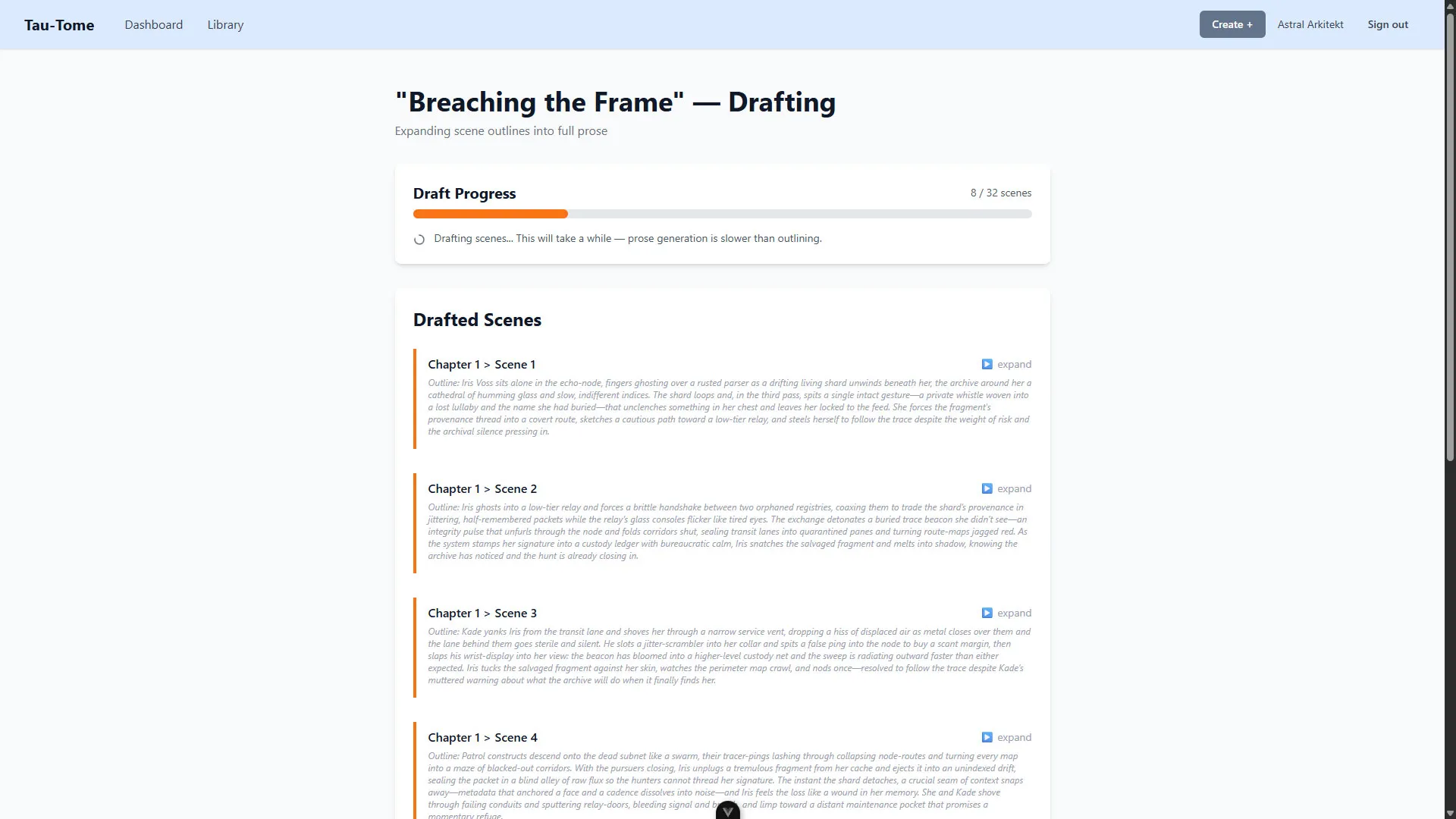
As you can see, I’m not letting this archaeology metaphor go.
After you’ve dusted the bones of your story, and excavated your very best ideas for the narrative you’re building, it’s time to set to drafting. This is where all the hard work really pays off and Tau-Tome can actually showcase it’s talent for expanding these outlines into full-blown prose. This is like reassembling the skeleton of an ancient human or dinosaur and seeing if they can still support their own weight with the pins and wires to hold them up.
Those “pins and wires” are the mechanics of storytelling, and it doesn’t matter much if you write them, ai writes them, or an eighth grade A+ english student writes them. The mechanics of good storytelling can be applied at nearly any level, and you as the writerly voice in the room get to decide how advanced you get with your storytelling mechanics.
Do you choose to let the Tau-Tome dictate the final form of this story, or are you going to dive into that fiction and not only stand that skeleton up, but make the dang thing look like it’s roaring?
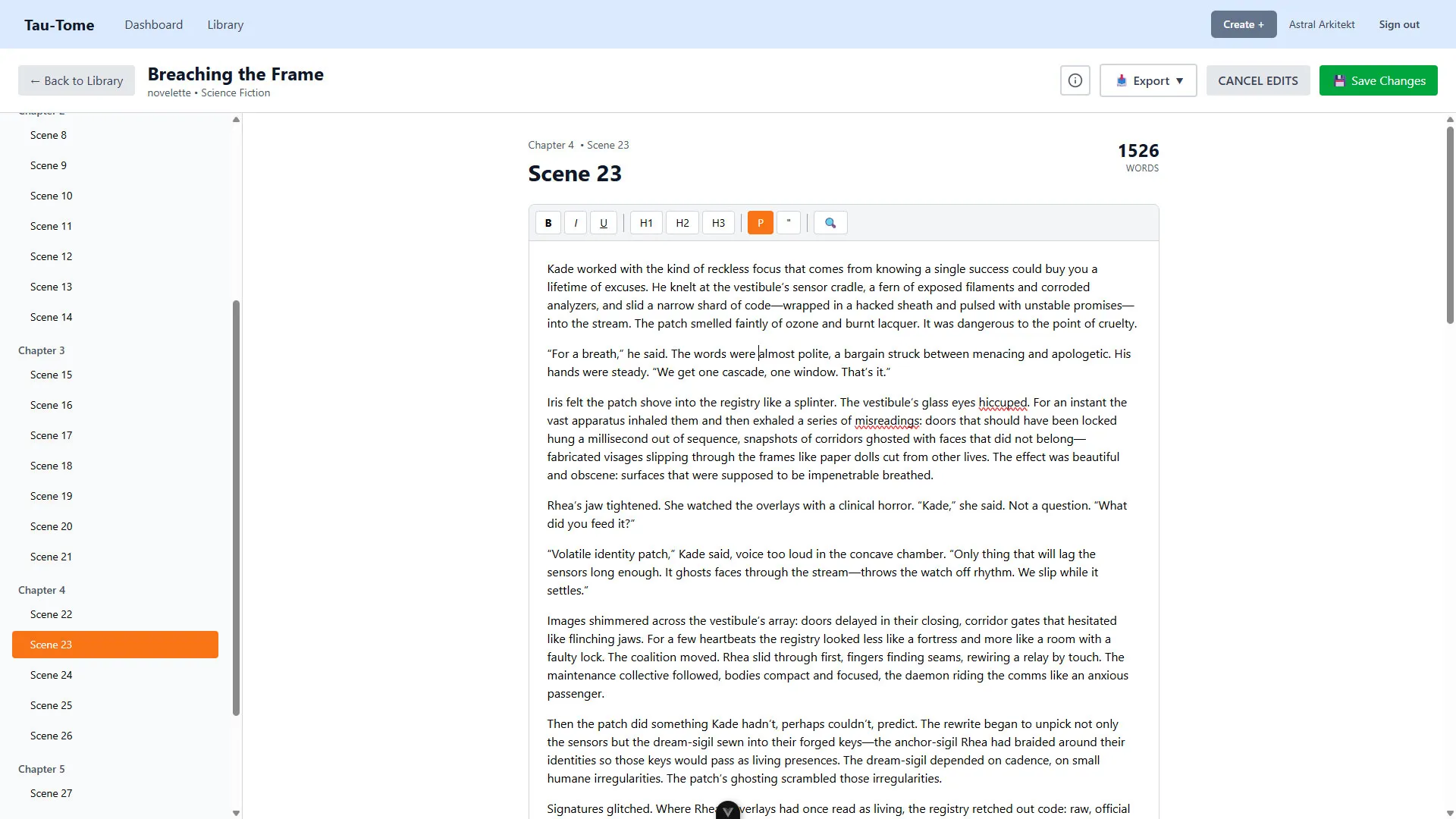
Well to do that, I created a simple but effective manuscript editor right inside of the Tau-Tome interface. You can read your drafts and make notes while you have that second cup of coffe right as the drafts come in “hot off the excavation site” - you thought I was gonna say hot off the presses, but I told you, I’m not letting the archaeology metaphor go.
The question I have for you is, what will you do with your draft once it’s complete?
Read it and call it a good way to spend an afternoon?
Will you idly poke at it and polish it into something you can truly call your own?
The choice is all yours. I just want to facilitate the journey.
I hope you’ll make it yours. I hope you’ll share it with the world.
I hope you’ve just found a new hobby.
Here’s what I created with my two cups of coffee!
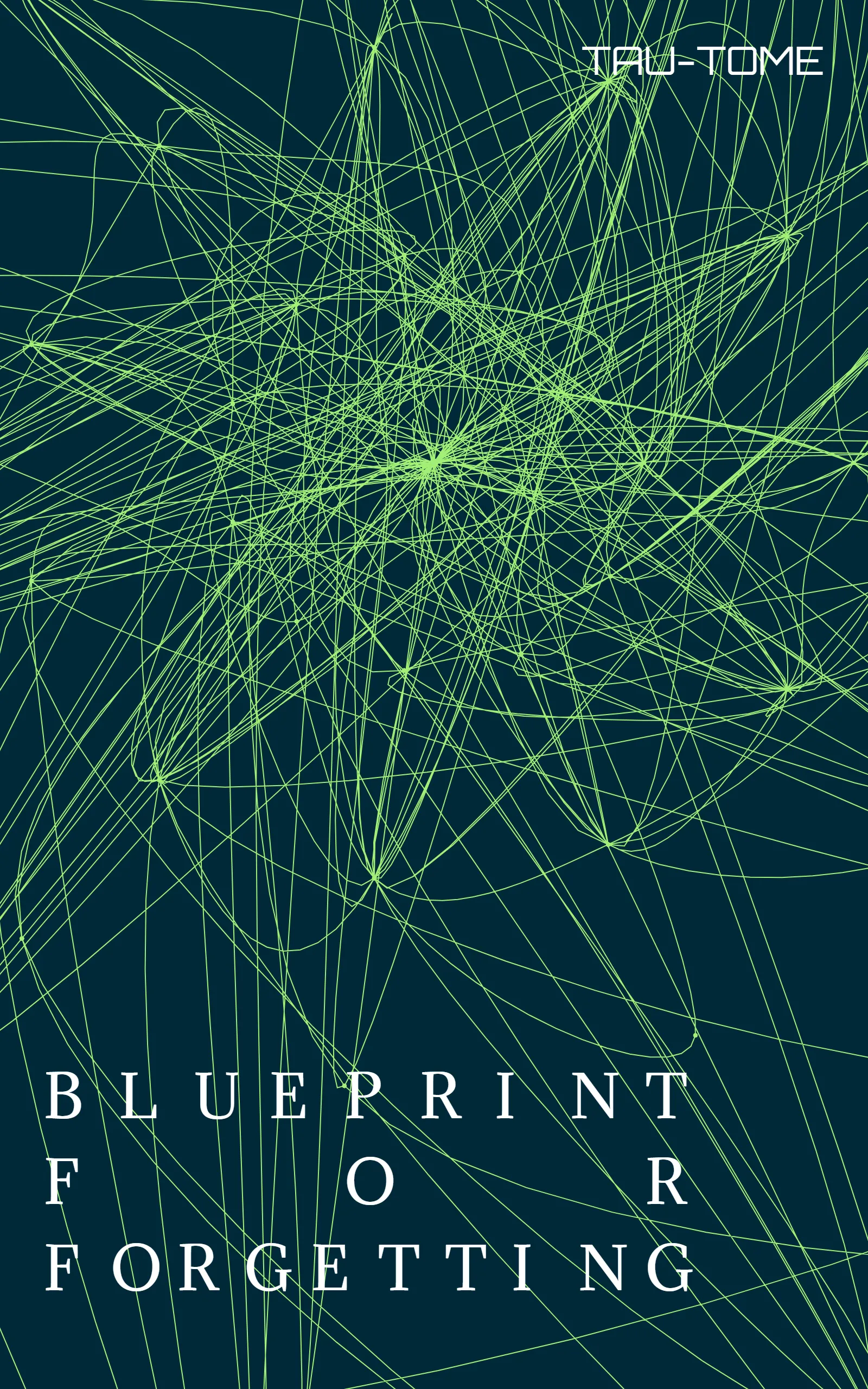
When Jacoby Lawson comes back to himself after six months of unconsciousness, the city insists he is a man he does not remember being. Files bear a life inked over his own; neighbors know milestones that feel newly grafted onto his skin. Above the skyline, a pale object hangs with a patience that reads like choreography—an unmoving trespasser that refracts the past and watches as beginnings are quietly redrawn. Jacoby was an urban designer who built certainty from plans and joins. Waking into a life whose blueprints have been rubbed out, he tries to measure his loss the only way he knows: by mapping the gaps. Small things yield the first proofs—a joist carved with a date that will not match, a marginal note erased and reappearing like a scar, a shard of metal whose cold suggests deliberate incision. A confessional companion in the ward offers a final, dreadful confirmation: truth that costs whatever is left of speech. A newcomer in the rain, Aure Liao, appears on his first day outside the hospital with an unsettling steadiness and a question that becomes accusation. Her arrival is not coincidence; it is a key. Pulled between the methodical patient who records everything and the quiet bureaucrats who insist records are law, Jacoby finds allies in unlikely corners: a weary neurologist who writes careful doubts into margins, a municipal archivist who reads erasures as fingerprints, an orbital analyst whose charts register the visitor as a slow, deliberate anomaly, and a retired satellite operator who teaches how to make noise in a sky that prefers silence. Together they trace the geometry of an interference that does not smash so much as recompose—small misalignments that accumulate until bridges lean and rooms no longer open the way they should. With shifts from low, interior dread—domestic rituals that collapse into uncanny misfits—to staccato bursts of terror when someone who remembers the “other” Jacoby comes too close. Every revelation is a construction site: peeling tape from a doorframe, unscrewing a plate, reading a ledger’s margins. Each repair yields a new fracture. The visitor in orbit never rages; it experiments, rearranges, and waits to see what new being will hold. A dark confession sits at the story’s center: can a man reclaim his origin by tearing down its tidy anchors, or will acceptance of a rewritten past keep him whole but hollow? In taut, atmospheric prose, Blueprint for Forgetting bends cosmic trespass into an intimate reckoning—an elegy for authorship, and a slow, irresistible unmaking under a sky that is learning how to write
You can download and read it for free here: https://tools.astralarchitecture.com/downloads/blueprint-for-forgetting.epub https://tools.astralarchitecture.com/downloads/blueprint-for-forgetting.pdf
This is what Tau-Tome can do with only human intervention at the concept editing stage. I did not edit the drafts at all. I simply read them as they came in and then compiled them into a manuscript. The only thing I did was edit the concept, which is the stage where you can make small edits to the premise, plot and promise.
The Recursion: What did we really do today?
We recursed. Think about it…
Recursing means to take the output of one process and feed it back to itself. We did that. We recursed.
That’s what real writers do.
We fed Tau-tome an idea and got the three P’s of Tau-Tome.
Promise.
Premise.
Plot.
These were derived recursively. First the premise. Then the premise is fed to the outliner. Then the outline is fed to the promise.
Then we fed all that to the outline expander to flesh out the rest of the story.
Then we fed the outline to the drafter to output the prose.
You learned the entire writing process, and you hopefully had fun doing it.
This is what real writer’s do. They recurse through these steps to create great fiction.
Today, you’ve hopefully gotten a taste of that… What it’s like to dig up the bones of a great idea and then like an archaeologist, assemble those parts into something awe-inspiring.
And all it cost you was two cups of coffee.
Real Writers Recurse.
Want to give Tau-Tome a Test Drive? Let’s RWR!
Sign up for the Astral Architecture newsletter (below) to get notified when Tau-Tome is available for public use, and to get access to the private beta when it launches.